When looking at the future of the oil and gas industry, it is important to understand the term "pollutant" as it relates to carbon dioxide (CO2). CO2 is often labeled as a "greenhouse gas," but this can be misleading without proper context. CO2 is crucial for Earth's ecosystems; it is necessary for photosynthesis, the process by which plants turn carbon dioxide into oxygen. This process supports plant life, which in turn supports animal life, including humans. Can you say, "Essential Nutrient"?
Big Oil
When looking at the future of the oil and gas industry, it is important to understand the term "pollutant" as it relates to carbon dioxide (CO2). CO2 is often labeled as a "greenhouse gas," but this can be misleading without proper context. CO2 is crucial for Earth's ecosystems; it is necessary for photosynthesis, the process by which plants turn carbon dioxide into oxygen. This process supports plant life, which in turn supports animal life, including humans. Can you say, "Essential Nutrient"?
| Thus, describing CO2 simply as a pollutant overlooks its fundamental contributions to life on Earth.
As we engage in discussions about environmental policies and regulations, particularly in regions like California, it is imperative to present these facts to government officials and policymakers. An informed dialogue that recognizes the importance of CO2 can lead to a more balanced understanding of its role in both natural processes and the broader context of climate science. Advocating for a nuanced perspective on CO2 is essential to avoid oversimplification and to promote responsible energy practices that ensure both environmental sustainability and economic viability.
When looking at the future of the oil and gas industry, it is important to understand the term "pollutant" as it relates to carbon dioxide (CO2). CO2 is often labeled as a "greenhouse gas," but this can be misleading without proper context. CO2 is crucial for Earth's ecosystems; it is necessary for photosynthesis, the process by which plants turn carbon dioxide into oxygen. This process supports plant life, which in turn supports animal life, including humans. Can you say, "Essential Nutrient"?
Marc Bruner on Real America's Voice: Lost Soldier's Operations and the Outlook for American Energy
Aug 10, 2026
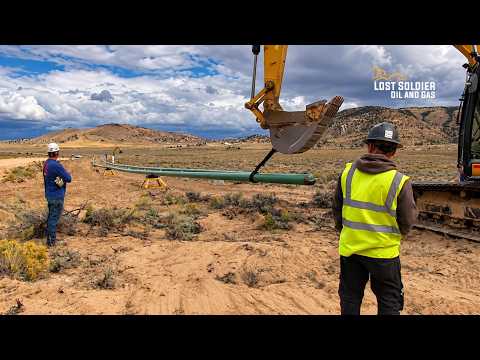
Lost Soldier Founder & CEO Marc Bruner joined Grant Stinchfield on Real America's Voice for another wide-ranging conversation, this time covering the company's Wyoming operations, the broader outlook for American energy production, and how Lost Soldier is approaching its next phase of development at the Wild Mustang Federal Unit in the Bison Basin.
To learn more, visit: https://lostsoldier.com/
Marc Bruner Returns to Real America's Voice: Wyoming Energy & What's Next for Lost Soldier
Aug 3, 2026
Lost Soldier Founder & CEO Marc Bruner joined Grant Stinchfield on Real America's Voice for another wide-ranging conversation, this time covering the company's Wyoming operations, the broader outlook for American energy production, and how Lost Soldier is approaching its next phase of development at the Wild Mustang Federal Unit in the Bison Basin. This marks another appearance for Marc on Real America's Voice, continuing an ongoing dialogue with Grant Stinchfield about domestic energy development and Lost Soldier's work in central Wyoming.
Lost Soldier Oil and Gas Founder & CEO Marc Bruner joins Grant Stinchfield to discuss the company's Wyoming natural gas project, its development strategy, existing infrastructure, and long-term vision for domestic energy production. Marc also shares updates on the company's current private placement for accredited investors and management's focus on building long-term shareholder value.
To learn more, visit: https://lostsoldier.com/
Marc Bruner on Stinchfield Tonight | Inside Lost Soldier's Wyoming Natural Gas Project
July 14, 2026
Marc Bruner, Founder and CEO of Lost Soldier Oil and Gas, joins Grant Stinchfield on Stinchfield Tonight to discuss the company's Wyoming natural gas project, development plans, and long-term vision.
The conversation covers drilling progress, infrastructure development, the private placement available to accredited investors, and the company's strategic outlook.
When looking at the future of the oil and gas industry, it is important to understand the term "pollutant" as it relates to carbon dioxide (CO2). CO2 is often labeled as a "greenhouse gas," but this can be misleading without proper context. CO2 is crucial for Earth's ecosystems; it is necessary for photosynthesis, the process by which plants turn carbon dioxide into oxygen. This process supports plant life, which in turn supports animal life, including humans. Can you say, "Essential Nutrient"?
Thus, describing CO2 simply as a pollutant overlooks its fundamental contributions to life on Earth.
As we discuss environmental policies and regulations, particularly in regions like California, it is imperative to present these facts to government officials and policymakers. An informed dialogue that recognizes the importance of CO2 can lead to a more balanced understanding of its role in both natural processes and the broader context of climate science. Advocating for a nuanced perspective on CO2 is essential to avoid oversimplification and to promote responsible energy practices that ensure both environmental sustainability and economic viability.
In considering the future of the oil and gas industry beyond 2024, it is essential to clarify the often-misguided use of the term "pollutant" when referring to carbon dioxide (CO2). While CO2 is frequently labeled as a "greenhouse gas," this characterization can be misleading without proper context. CO2 plays a vital role in Earth's ecosystems; it is essential for photosynthesis, the process by which plants convert carbon dioxide into oxygen, sustaining plant life and, by extension, animal life, including humans.
Additionally, CO2 is a natural byproduct of respiration in mammals. Every time we exhale, we release carbon dioxide into the atmosphere, highlighting its inherent role in life on Earth. Therefore, labeling CO2 simply as a pollutant overlooks its essential role in our existence and its fundamental contributions to life.
As we discuss environmental policies and regulations, particularly in regions like California, it is crucial to present these facts to government officials and policymakers. An informed dialogue that recognizes the importance of CO2 can lead to a more balanced understanding of its role in natural processes and the need for responsible environmental practices.
Our Founder and CEO, Marc Bruner, returns to Stinchfield Tonight with Grant Stinchfield to discuss active development at the company's Wild Mustang Federal Unit in Wyoming, a high-pressure natural gas project featuring multiple stacked reservoirs across a significant acreage position, with geological characteristics the company believes are comparable to some of the most productive fields in the region.
Marc covers the project's current wells, planned deeper drilling, ongoing pipeline buildout, and initial production activity, as well as what the company's multi-zone lease position may mean for long-term development potential.
To learn more, visit: https://lostsoldier.com/
Marc Bruner, Founder & CEO of Lost Soldier Oil & Gas, joins Grant Stinchfield on Real America’s Voice to discuss the company’s advancing natural gas project in Wyoming.
The discussion covers the scale of the discovery, multiple stacked reservoirs, early well performance, and the broader development strategy behind what management views as one of the most significant gas opportunities in the Western U.S. in decades.
To learn more, visit: https://lostsoldier.com/
Marc Bruner & Grant Stinchfield: A Closer Look at the Lost Soldier Opportunity
Apr 27, 2026
Marc Bruner, Founder & CEO of Lost Soldier Oil & Gas, joins Grant Stinchfield of Real America's Voice to provide an inside look at the company’s Wyoming-based project and its ongoing development.
The discussion highlights the project’s structure, including overriding royalty interests, the scale of the resource, and how the opportunity is being positioned within the broader energy landscape.
To learn more, visit: https://lostsoldier.com/
California Just Lost a 115-Year Giant — And It’s a Warning
Apr 27, 2026
California just lost a 115-year icon — and almost nobody saw it coming.
Blue Diamond Growers, the world’s largest almond company and a cornerstone of Sacramento’s economy since 1910, is shutting down its historic manufacturing plant. For over a century, this facility employed generations of families and helped build California’s dominance in global agriculture.
Now, more than 600 jobs are disappearing, a 50-acre historic site is being left behind, and the city is facing a difficult question: what went wrong?
In this video, we break down the real reasons behind the closure — from rising costs and aging infrastructure to deeper economic pressures that could signal a much larger shift happening across California.
This isn’t just one company leaving. It may be a warning.
The World’s Biggest Mozzarella Maker Just Left California - 300 Jobs Gone
Apr 22, 2026
The world’s biggest mozzarella producer just made a decision that could reshape American manufacturing.
Leprino Foods — the company behind most of the pizza cheese consumed in the United States — has shut down a 115-year-old facility in California and shifted its future to Texas, taking hundreds of jobs with it.
This isn’t just about one factory closing. It’s about rising costs, energy prices, regulation, water shortages, and a changing economic landscape that is quietly pushing major manufacturers out of California.
For decades, this company has supplied giants like Pizza Hut, Domino's, and Papa John's — making it one of the most influential food producers you’ve probably never heard of.
So why did they leave?
And what does it say about where jobs, industry, and investment in America are heading next?
Our President & CEO, Marc Bruner, joined Kip Herriage, founder of Vertical Research Advisory, to discuss Lost Soldier Oil & Gas and the opportunity surrounding one of the most significant natural gas discoveries in the Western United States.
The conversation explores the company’s strategy, resource potential, and the broader outlook for U.S. natural gas.
▶️ 𝐖𝐚𝐭𝐜𝐡 𝐭𝐡𝐞 𝐟𝐮𝐥𝐥 𝐰𝐞𝐛𝐢𝐧𝐚𝐫: https://tinyurl.com/55ywt26k
#Energy #NaturalGas #EnergyMarkets #USA
Dr. Jerome Corsi has a PhD from Harvard in political science. He is a senior staff reporter for WND and is the author of several books including "The Obama Nation", co-author of "Black Gold Strangle Hold: The Myth of Scarcity and the Politics of Oil" and the newly released, "The Great Oil Conspiracy: How the U.S. Government Hid the Nazi Discovery of Abiotic Oil from the American People"
You may recall learning that oil was allegedly formed by decaying matter from dead dinosaurs. Eventually this was changed to communicate that it was formed by the decaying of ancient forests. When that theory was abandoned, credit was given to plankton and other deep-earth biological materials. Dr. Corsi says it's all nonsense.
The Nazi's, who had been making synthetic oil out of coal, knew that oil is abiotic and not a fossil fuel that is biologically made from certain types of decaying matter. They developed what's known as the Fischer-Tropsch equations which explained that the earth makes oil under intense pressure and heat deep within the earth on an ongoing basis.
To prove his point, Dr. Corsi noted that there is approximately 1.38 trillion barrels of oil in known oil reserves, the most in human history, despite the fact that consumption of oil has doubled since the 1970's.
Are the environmentalists and our government being dishonest with us when they claim we are running out of oil? You decide when you review this edition of Crosstalk.
More Information:
To obtain a copy of "The Great Oil Conspiracy: How the U.S. Government Hid the Nazi Discovery of Abiotic Oil from the American People" by Jerome Corsi, call the VCY Bookstore at 414-722-4829. Dr. Corsi's book is also available on the Internet in e-book form.
Canada IN SHOCK As Alberta ANNOUNCED Major New US Pipeline Deal!
⚠️ Disclaimer
Content Context: The videos on this channel may explore unverified information or theories gathered from public sources and media reports. They are intended for educational and informational purposes only and should not be interpreted as confirmed facts.
Intent: David Fraser does not seek to discredit or defame any individuals, organizations, or groups. The goal is to promote thoughtful dialogue and critical analysis.
California just lost one of its biggest breweries — and the consequences are already hitting store shelves. Budweiser’s massive Fairfield facility has officially shut down, leaving hundreds of workers without jobs and putting major pressure on beer prices across the state. From rising taxes to strict regulations and collapsing demand, California’s beer industry is facing a crisis nobody wants to talk about.
Why did Bud leave?
Who’s responsible?
And how high will beer prices go now?
In this video, we break down the real reasons behind this shocking shutdown, what it means for your wallet, and why more breweries could follow. Buckle up — because this is only the beginning.
Want to verify the facts in this video? Here are all the credible sources we used for our research:
Valero CEO DESTROYS Governor Of California After Leaving California!
Interested in reviewing the research behind this video? There's a complete list of the reliable sources I used in the comment section.
Disclaimer: I am an energy market enthusiast, not a licensed commodities trader, petroleum analyst, or financial advisor. All content shared here is based on publicly available data (such as WTI/Brent indices), my own observations of global trends, and personal opinions. This information is intended strictly for entertainment and general knowledge. I cannot guarantee the accuracy of the market data presented, as prices are highly volatile. Please always consult a qualified financial advisor or energy sector professional before making any investment decisions regarding oil futures, energy stocks, or fuel hedging.
Governor Of California PANICS After Phillips 66 Gas Refinery Begins Shutting Down!
California's gas prices have reached crisis levels—and drivers across the Golden State are demanding answers. This video exposes the complex web of factors keeping California's fuel costs the highest in the nation. Discover how the state's strict refinery requirements, low-carbon fuel standards, and environmental regulations create a perfect storm for sky-high prices at the pump. Learn why California's unique fuel blend can only be produced by a handful of refineries, how the Cap-and-Trade program adds hidden costs to every gallon, and why even minor supply disruptions send prices skyrocketing. We'll explore the refinery shutdowns threatening California's fuel supply, the oligopoly of oil companies controlling the market, and whether the state's aggressive push toward electric vehicles offers any relief for frustrated drivers still dependent on gasoline.